Strong governance, strained systems: what 32 universities revealed about Admissions
International admissions is under more pressure than ever, and not just to deliver numbers.
Rising competition, shifting student flows, tighter compliance requirements and changing student expectations are redefining what good looks like. At the same time, universities are being asked to deliver growth using systems and processes that were never designed for this level of complexity.
Across the sector, teams are responding with commitment and resilience. In many cases, they are holding things together remarkably well. But there is a limit to how long workarounds can carry the load and many teams are operating close to that edge.
The question is not whether admissions is functioning, but whether it is ready for what comes next.
Putting admissions capability under the microscope
To explore that question, Edified was engaged by Flywire to deliver the Admissions Navigator 2025, a sector-wide benchmarking study of international admissions capability in the UK.
The framework was co-developed by Edified, Flywire, Tribal and admissions leaders from 18 UK universities, establishing a shared view of the capabilities required for success over the next three to five years. It was then used by 32 institutions to assess their current position.
The research stage was completed by Edified, drawing on our experience in research design and admissions transformation to ensure the findings were both robust and grounded in operational reality.
A system that works, but is under strain
The findings point to a sector that has made real progress, but is carrying an increasing operational burden. No institution was rated as future-ready. The average future readiness score was 54% and confidence in meeting future needs was just 4.7 out of 10.
At most institutions, capability is uneven. Governance is the clear standout, with an average score of 74%. In contrast, operational excellence sits at 41% and the applicant journey at 43%, highlighting a significant gap between oversight and execution.
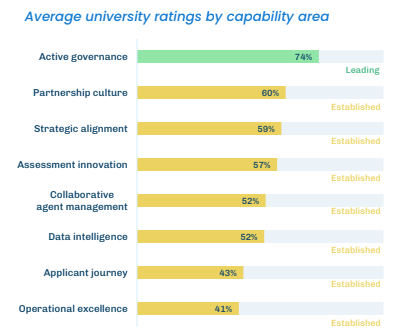
This imbalance shows up in how admissions operates day to day. Institutions are strong on policy, compliance and risk visibility, but often constrained by manual workflows, fragmented systems and
limited automation.
As one participant put it:
“We are getting by, we are working hard, but we need to work smarter. Systems limitations are too often cited as a barrier, and too much time is spent on manual workarounds.”
Admissions is functioning, but often through effort rather than efficiency.
A gap that reinforces itself
The lowest-scoring areas, operational excellence, the applicant journey, and data intelligence, are not separate problems. They are all symptoms of the same underlying challenge: a lack of coordinated execution across functions.
Fragmented data limits automation. Limited automation increases manual workloads. Manual processes reduce the capacity to improve systems and enhance the applicant experience. Each gap reinforces the others, creating a cycle that is hard to break.
Even when institutions are aware of these issues, progress is slow.
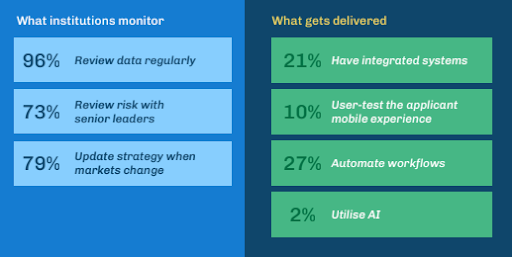
Most are actively reviewing data, adjusting strategy and involving senior leaders in decision-making. Yet only 21% report having integrated systems, 27% have automated workflows and just 2% are using AI.
Awareness is not the problem, but alignment and execution are.
Successful international admissions relies on multiple functions working together, including admissions, pathways, international recruitment, IT, finance, and compliance. This is where institutions often get stuck.
Without coordinated action, institutions remain reactive rather than adaptive, limiting the ability to improve efficiency, the applicant experience and long-term outcomes. This is where we see the biggest opportunity.
Turning insight into progress
Institutions making real progress don’t just react to daily challenges. They treat admissions as a strategic function and have a clear roadmap for long-term improvement.
Here are some practical steps you can take now to strengthen your admissions capability:
- Set clear admissions priorities
Define service levels by course and market so teams work to a unified strategy aligned to your recruitment objectives.
- Turn applicant insights into action
Analyse where applicants struggle and make improvements in processes, communications and digital interfaces.
- Create a reference for global qualifications
Standardised requirements reduce ad hoc decisions and provide a scalable, transparent foundation to assist staff, agents and applicants.
- Give agents the right tools
Provide a tailored portal to help them manage applications, track progress and track commission.
- Don’t leave agent performance flat
Use tiered servicing to recognise top agents with better support and turnaround times.
- Use AI where it adds value
Automating complex assessment decisions with the help of AI technology can dramatically reduce turnaround times and help with personalisation at scale. Take Edified's admissions automation readiness assessment to see if your institution is ready for this next phase.
There is no single solution, and no institution starts from the same place. What matters is having a clear view of where to focus, and the alignment to move forward.
One way to get started is through a comprehensive, expert view of your admissions operations.
Edified’s Admissions Appraisal and Success Plan offers a detailed evaluation of your current processes and a prioritised roadmap, helping you focus on the initiatives that will deliver the greatest impact and set you up for long-term success.
Explore the findings
Get your copy of the Admissions Navigator 2025 summary report. It provides a sector-led view of where international admissions stands today in the UK and where it needs to go next.
Get in touch
If the findings resonate, we would welcome a conversation about what this means for your institution. Reach out to explore how Edified can support your next steps.

Elissa Newall
Senior Partner
Book a meeting